








News
6 wheel stair climbing shopping trolleys: how they work on steps
Six wheel shopping trolleys use two three wheel clusters that roll over a kerb or a step instead of stopping at it. How they work and who they suit.
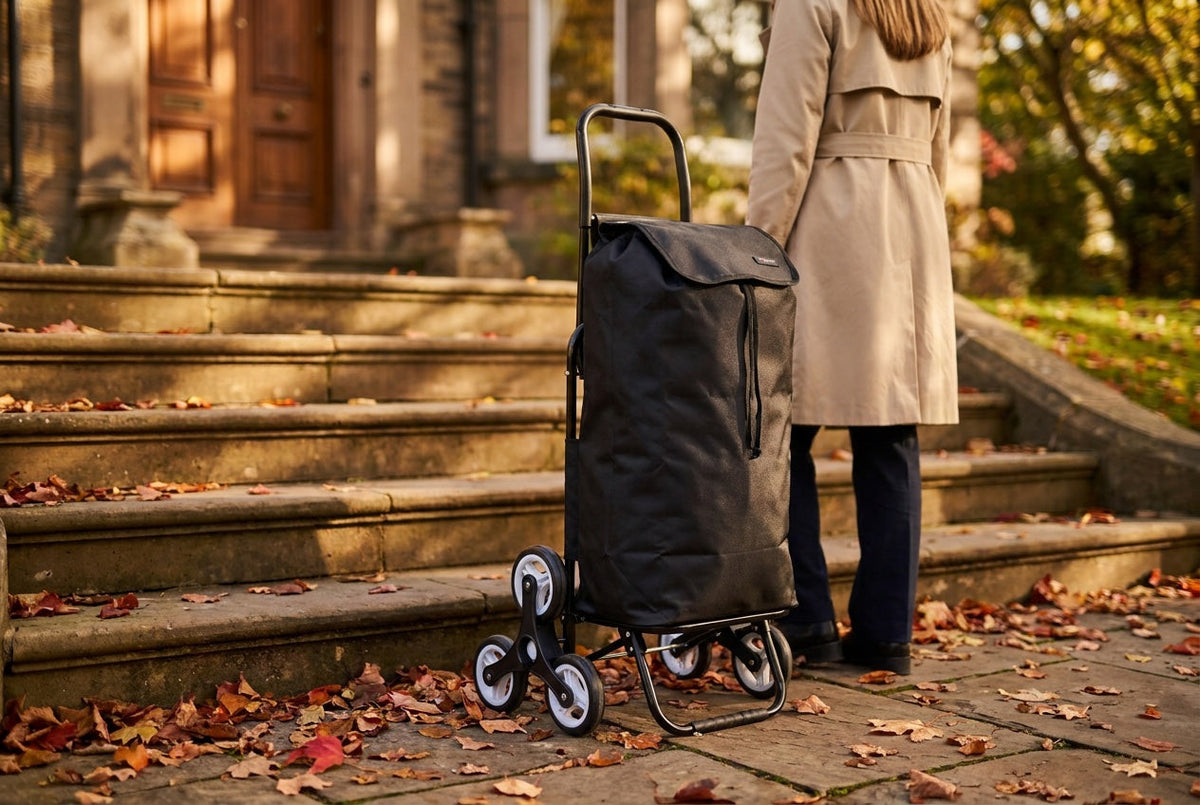
A six wheel shopping trolley has three wheels on each side, arranged round a hub. On flat ground two of them roll; at a step or a kerb the cluster rotates, the top wheel lands on the edge and the trolley climbs instead of catching. It turns a flight of steps from a lift into a pull. Here is how the mechanism works, where it helps, where it does not, and the two six wheel trolleys we sell.
How the tri-wheel cluster works
Picture a triangle of wheels on each side, free to rotate as a group about its centre. Pull the trolley along a pavement and the two lower wheels roll like any trolley. Reach a step: the front lower wheel hits the riser and stops. Keep pulling and, instead of the trolley jolting, the whole triangle pivots about that stopped wheel, bringing the top wheel over and down onto the step. The next step repeats it. You feel a gentle rock, not a lift. Coming down works the same way in reverse, and on cobbles the cluster rocks over the bumps.

Where six wheels help
- A flight of steps to the front door. The main reason to buy one.
- Kerbs without dropped crossings, and the step onto a bus.
- Markets and cobbled streets, where small wheels jam.
- Footbridges and underpasses with stairs and no ramp.
Where they do not help
On flat ground a six wheel trolley rolls no better than a good two wheel trolley and weighs more. The clusters add width, so it is bulkier on a bus. On very steep or very narrow steps the cluster can still catch, and a full 74 litre bag is 20 kg to pull up a flight regardless of how it rolls. Spiral stairs are not for any trolley.
Our six wheel trolleys
The 74L stair climber puts two tri-wheel clusters on a folding aluminium frame with a 74 litre drawstring bag and a sturdy folding handle; it weighs about 5 kg and folds to 90 x 39 x 25 cm. The 64L market cart is a different design: six detachable wheels on an iron frame with a lock. Both are in the six wheel trolley collection; stock on each comes and goes, so check the page.
Two wheels, four or six?
If there are no steps in your life, buy a two wheel trolley with 20 cm wheels and save the money. If you push rather than pull, buy four wheels. Buy six wheels for steps. The full comparison is in two, four or six wheel shopping trolleys.
Looking after the clusters
Grit collects in the hub of a tri-wheel cluster. Rinse it after wet days and spin each wheel to check it turns freely. Do not oil the plastic bearings; it attracts dirt. Pull the trolley up steps at walking pace; yanking it up two at a time is what bends the axle pins.
Questions people ask
How does a six wheel shopping trolley work?
Each side has three wheels on a rotating hub. At a step the lower wheel stops, the cluster pivots and the top wheel rolls onto the step, so the trolley climbs without being lifted.
Are stair climbing trolleys worth it?
If you have steps between the shop and your door, yes. On flat ground a two wheel trolley with large wheels does the same job for less.
Can a stair climber trolley go down stairs?
Yes. The clusters rotate the same way in reverse. Keep a firm hold; the trolley rolls as soon as a wheel is over the edge.
How much can a six wheel trolley carry?
Ours carry 64 to 74 litres, a full weekly shop. The limit on steps is what you can pull, 15 to 20 kg for most people.
Do six wheel trolleys fold?
Yes. The stair climber folds to a flat panel about 25 cm deep with the clusters on; the market cart's six wheels detach.