








News
How to weigh a suitcase at home
Three ways to weigh a suitcase at home: a hanging luggage scale, bathroom scales and the subtraction method. How accurate each is and when to re-weigh.
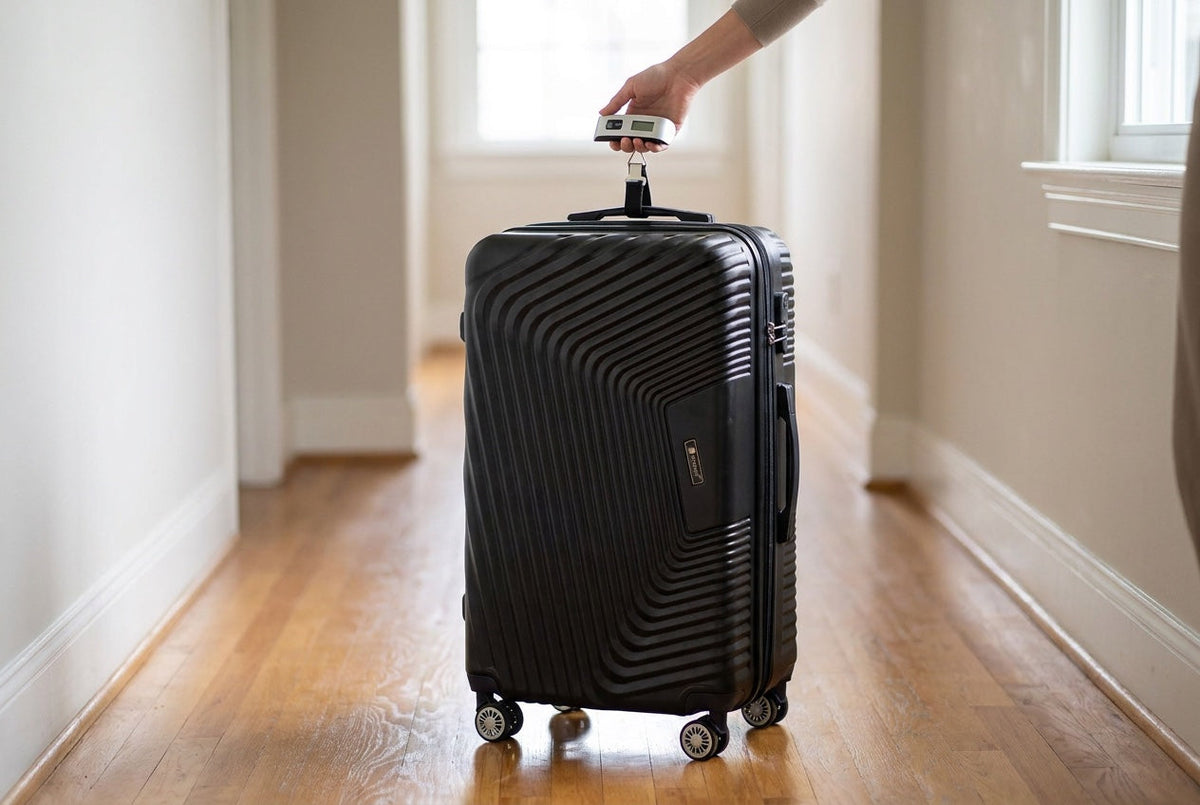
The quickest way to weigh a suitcase at home is a hanging luggage scale: hook it through the handle, lift, and read the display. If you do not have one, stand on the bathroom scales holding the case and subtract your own weight. The first method gets you within a couple of hundred grams, the second within about half a kilo, which is enough to keep you clear of a 23 kg limit as long as you leave a margin.
Method 1: a hanging luggage scale
- Zero the scale and loop the strap or hook through the top handle of the case.
- Lift with a straight back until the case is clear of the floor and still. Hold for two or three seconds.
- Read the locked weight. Most digital scales beep and hold the number so you can put the case down first.
- Weigh it twice. If the two readings differ by more than 200 g, the case was swinging.
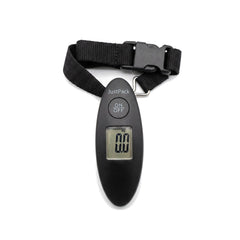
Our scales take up to 35 kg, 40 kg or 50 kg depending on the model. The 50 kg Ezzyrol 734E covers anything an airline will accept; the pocket sized JustPack Gauge at 40 kg lives in the case for the trip home.
Method 2: bathroom scales and subtraction
- Weigh yourself. Write it down.
- Pick up the case and step on again. Hold it close to your body so you are not leaning.
- Subtract the first number from the second.
Bathroom scales round to the nearest 100 g to 500 g and read differently if the floor is carpet or if your weight is off centre, so treat the answer as plus or minus half a kilo. Do not put the case straight on the scales: four wheels spread the load onto the edges and most scales under-read.
Method 3: a kitchen scale for the small stuff
If the case is close to the limit, weigh the heavy items individually on a kitchen scale and decide what to leave: a hairdryer is about 600 g, a pair of trainers 700 g to 900 g, a 500 ml bottle of toiletries 550 g, a paperback 300 g. Moving two pairs of shoes to your cabin bag takes 1.5 kg off a hold case.
What to weigh against
The hold bag you paid for: 15 kg or 23 kg on easyJet, 20 kg on Ryanair and most TUI holidays, 22 kg on Jet2, 23 kg on British Airways. Cabin bags are rarely weighed on UK airlines but Jet2, TUI and Ryanair Priority set 10 kg, easyJet 15 kg and some long haul airlines 7 kg or 8 kg. Give yourself a margin of 500 g at home, because the airport scale is the one that counts and it will not be the one you used.
Weigh it twice: before you go and before you come back
The flight home is where the surcharges happen. Shopping, bottles from duty free and wet towels add kilos that were not there on the way out. A small scale in the case takes thirty seconds at the hotel and avoids a fee of £10 to £15 a kilo at the desk.
Questions people ask
How do you weigh a suitcase without a luggage scale?
Weigh yourself on bathroom scales, then weigh yourself holding the suitcase, and subtract. It is accurate to about half a kilo.
Are luggage scales accurate?
A digital hanging scale is close enough for an airline limit if the case is held still, usually within a couple of hundred grams. Bathroom scales are good to about 500 g with the subtraction method.
Can you put a suitcase on bathroom scales?
You can, but the wheels put the weight on the edges of the platform and most scales under-read. Hold it and subtract instead.
Where can I weigh my suitcase?
At home with a luggage scale or bathroom scales, at some hotel receptions, and at the airport, where self service bag drops and check-in desks show the weight before the tag is printed.
What is the weight limit for a suitcase?
The bag you paid for: typically 15 kg to 23 kg on UK airlines, with 32 kg the most any airline will load in one bag.